Published on July 21, 2026

Bagikan artikel:
The beginning of a new school year often feels like a fresh start.
Parents buy new school supplies, children prepare for new classrooms, and families begin talking about hopes for the months ahead.
Yet, despite all the excitement, one challenge remains surprisingly common.
Many children start learning English with enthusiasm, only to lose motivation a few weeks later.
The problem is not always a lack of ability.
Nor is it because children dislike English.
More often, they simply don’t have a meaningful goal to work toward.
When learning feels like a series of assignments instead of a personal journey, consistency becomes difficult.
That is why setting clear and realistic learning goals can make a remarkable difference.
When parents think about academic goals, they often imagine report cards and exam results.
“I hope my child scores above 90.”
“I want them to be at the top of the class.”
While academic achievement is important, goals focused solely on outcomes can unintentionally create pressure instead of motivation.
Children learn more effectively when their goals are connected to meaningful progress rather than perfect results.
Instead of saying,
“Get an A in English,”
consider goals like:
These goals help children recognize their own progress, making learning feel achievable and rewarding.
Educational psychology consistently shows that intrinsic motivation—the desire to learn because it is personally meaningful—creates stronger and more sustainable learning habits than external rewards alone.
When children participate in setting their own goals, they begin to see learning as something they choose, not something they are forced to do.
Instead of studying to avoid criticism, they study because they enjoy seeing themselves improve.

That small shift in mindset often becomes the foundation of lifelong learning.
Many parents believe they need to create learning plans for their children.
In reality, children are far more engaged when they help shape those goals themselves.
Try asking questions such as:
Simple conversations like these encourage children to take ownership of their learning journey.
When goals are created together, commitment naturally follows.
Avoid comparing your child with classmates.
Instead, focus on their own progress and celebrate every improvement.
Realistic goals build confidence.
Ownership creates motivation.
Ask your child what they would genuinely like to achieve rather than deciding everything for them.
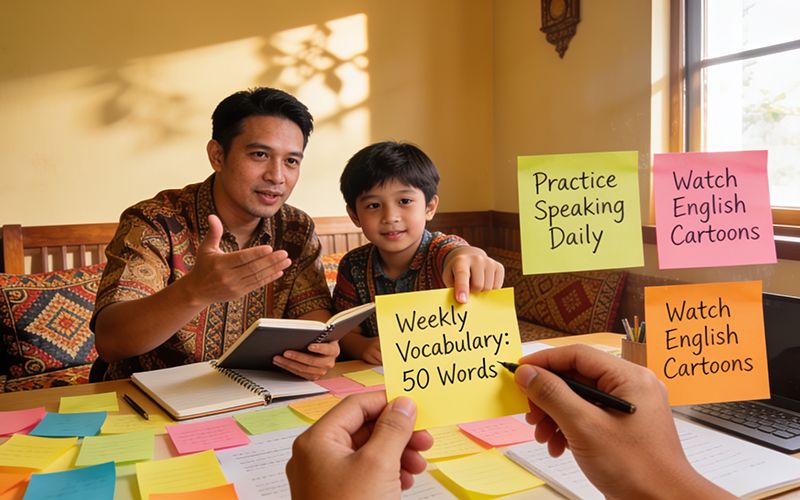
Goals such as “study harder” are difficult to track.
Instead, create goals like:
Specific goals make progress visible.
Large ambitions can feel overwhelming.
Smaller milestones create regular moments of success, helping children stay motivated throughout the learning process.
Praise children for showing up consistently, trying new words, or speaking with confidence—even if they make mistakes.
Recognizing effort teaches children that growth is built through practice, not perfection.
Setting learning goals is only the beginning.
To make those goals realistic and achievable, parents also need to understand their child’s current English proficiency.
Knowing where a child starts makes it much easier to choose appropriate learning materials, learning strategies, and future goals.
A clear destination is important—but knowing your starting point matters just as much.

The best learning goals are not the biggest ones.
They are the ones that encourage children to keep moving forward.
This week, take a few minutes to sit down with your child.
Ask them what they hope to achieve in English this semester.
Write those goals somewhere visible.
Review them together.
Celebrate every small step along the way.
Because consistent learning doesn’t begin with a perfect schedule.
It begins with a meaningful purpose.
Start by writing down one English learning goal with your child today—and take the first step together.
***

Previous
Rekomendasi Game Edukatif Anak
Next
7 Metode Efektif Belajar Bahasa Inggris untuk Anak


10 Jun - 3 min read

10 Jun - 3 min read

10 Jun - 3 min read

10 Jun - 3 min read
Paling banyak dibaca
01
10 Jun - 3 min read
01
10 Jun - 3 min read
01
01
10 Jun - 3 min read
01
10 Jun - 3 min read
01
10 Jun - 3 min read
01
10 Jun - 3 min read
01
10 Jun - 3 min read
01
10 Jun - 3 min read
01
10 Jun - 3 min read
01
10 Jun - 3 min read
01
10 Jun - 3 min read

5/6/2024 5:11:50 AM - 3 min read

6/27/2024 8:10:51 AM - 3 min read
6/3/2026 4:04:11 AM - 3 min read

10/15/2024 4:40:33 AM - 3 min read

5/6/2024 8:04:23 AM - 3 min read

7/11/2025 4:26:17 AM - 3 min read

5/6/2024 8:06:24 AM - 3 min read

6/10/2024 3:29:56 AM - 3 min read

5/6/2024 5:21:03 AM - 3 min read

5/28/2024 11:02:22 AM - 3 min read
1/30/2025 11:15:01 AM - 3 min read

8/7/2024 3:54:20 AM - 3 min read