Published on June 23, 2026

Bagikan artikel:
Today's children are surrounded by English through YouTube, online games, social media, streaming platforms, and AI-powered tools. Yet many still struggle to communicate confidently in English. Why does this gap persist in an increasingly connected world?
One afternoon after school, 11-year-old Raka arrived home and immediately reached for his mother's tablet.
Without changing out of his school uniform, he settled into the living room, opened YouTube, and searched for the latest Minecraft video from his favorite creator. A few minutes later, he switched to Roblox. Not long after, he asked an AI chatbot for tips on creating a more engaging game character.
In less than an hour, Raka had probably encountered dozens of English words.
| Subscribe – Challenge – Upgrade – Mission – Level - Achievement.
He saw them every day.
Yet only days earlier, when his English teacher invited students to introduce themselves in front of the class, Raka fell silent.
He knew what he wanted to say.
But he wasn't sure how to say it.
For educators and parents across Indonesia, stories like Raka's have become increasingly familiar.
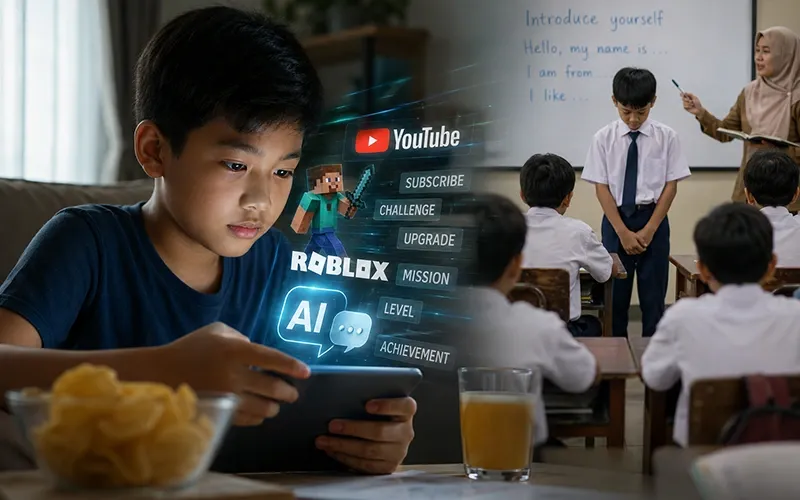
Children today live in a world fundamentally different from the one their parents experienced. English is no longer limited to textbooks, classroom exercises, or language courses. It has become woven into the fabric of daily digital life.
From YouTube videos and TikTok feeds to online games, streaming services, and AI-powered platforms, English is everywhere.
Ironically, the closer children become to English, the more a troubling question emerges:
If today's children are surrounded by English every day, why are so many still struggling to use it confidently?
This question lies at the heart of one of the most intriguing educational paradoxes of the digital age.
For many parents, learning English meant memorizing vocabulary lists, studying grammar rules, and completing written exercises in a workbook.
Exposure to English was limited and highly structured.
Today's children, however, belong to a completely different generation.
According to the Indonesian Internet Service Providers Association (APJII), internet penetration in Indonesia has surpassed 80 percent of the population.
Meanwhile, official government data show that internet access continues to expand rapidly across urban and rural communities alike.
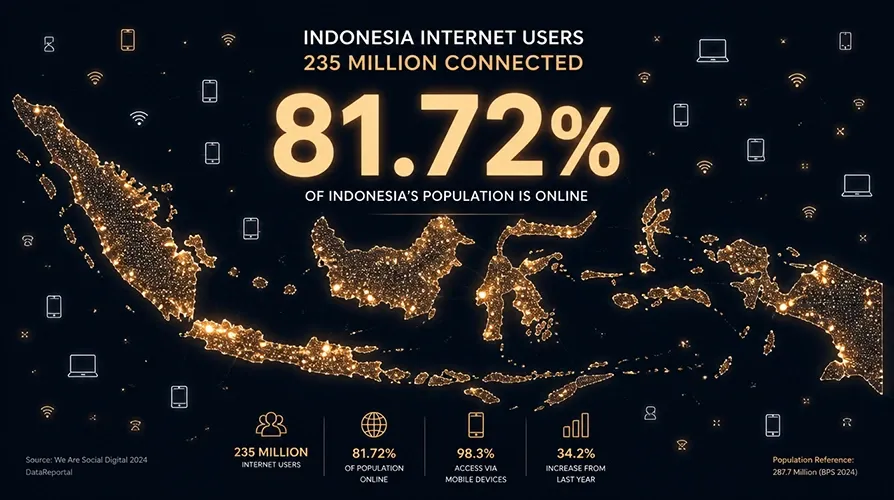
For millions of Indonesian children, the internet is no longer an occasional tool. It is an everyday environment.
And English exists everywhere within that environment.
When they watch Minecraft tutorials.
When they follow TikTok trends.
When they join multiplayer gaming communities.
When they search for answers using AI.
When they consume global entertainment.
Unlike previous generations that had to actively seek opportunities to encounter English, today's children are immersed in it.
They are arguably the first generation in Indonesian history to grow up continuously surrounded by English-language content.
Yet proximity does not automatically lead to proficiency.
And that distinction matters more than many people realize.
One of the most common assumptions among parents is that frequent exposure naturally leads to language mastery.
It sounds reasonable.
After all, if children hear English every day, shouldn't they eventually become fluent?
The reality is more complicated.
Language experts often distinguish between exposure and acquisition.
Exposure means hearing, seeing, or interacting with a language.
Acquisition means being able to understand, process, and use that language meaningfully.
The two are connected—but they are not identical.
Consider someone who listens to classical music every day.
Over time, they may recognize famous composers and distinguish between different instruments.
But that does not necessarily mean they can perform a symphony themselves.
Language works in a similar way.
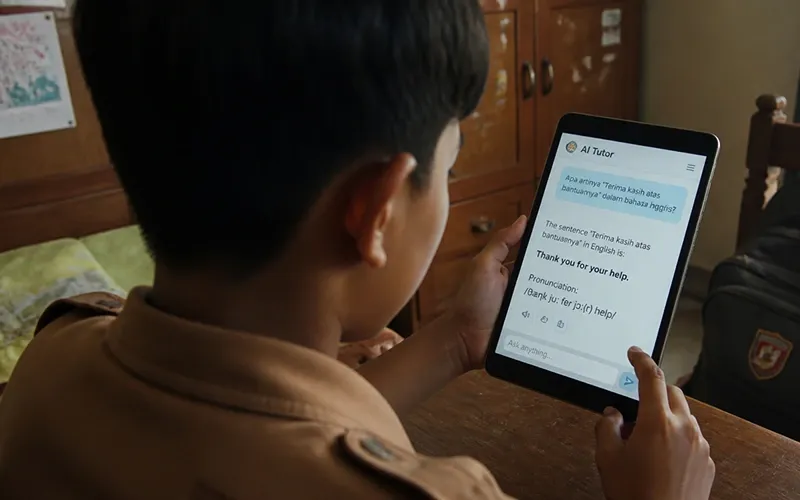
Children may recognize hundreds of English words through games, videos, and social media.
Yet recognition alone does not build confidence.
Confidence emerges through practice.
Through interaction.
Through making mistakes.
Through speaking.
And through receiving meaningful feedback.
In other words, exposure opens the door.
Acquisition happens when children walk through it.
Teachers are among the first to notice this shift.
An English teacher from Barito Kuala Regency describes a generation of students who are more familiar with English vocabulary than ever before.
"Students today already know many English words from YouTube, games, and social media. Terms like download, subscribe, challenge, or level up are part of their daily vocabulary."
Yet familiarity often masks a deeper challenge.
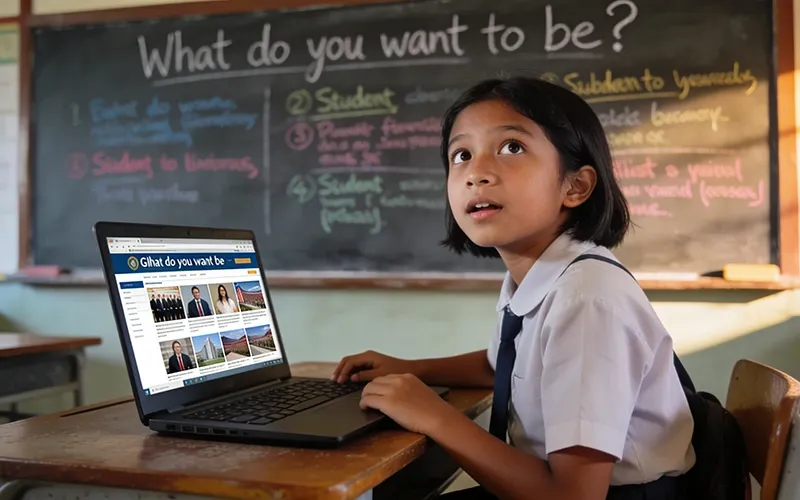
"When students are asked to build their own sentences, express opinions, or speak spontaneously, many still struggle. They recognize the words, but they are not yet comfortable using them."
The challenge facing educators has therefore evolved.
The goal is no longer simply introducing English to students.
The goal is helping students transform passive exposure into active communication.
The discussion around English proficiency is often reduced to grades, examinations, or rankings.
Yet the implications are much broader.
Today's students will enter a world shaped by globalization, digital collaboration, and rapidly evolving technologies.
Many future opportunities—whether in higher education, entrepreneurship, technology, or international careers—will require the ability to engage with people, information, and ideas across borders.
English remains one of the most important gateways to that global ecosystem.
This does not mean every child must become perfectly fluent.
But it does mean that developing meaningful communication skills is becoming increasingly valuable.
The challenge is no longer access.
The challenge is transformation.
How do we help children move from consuming English content to confidently using English themselves?
Indonesia has made significant progress in expanding digital access.
Children have smartphones.
They have tablets.
They have internet connections.
They have online learning platforms.
They have AI.
They have access to more information than any previous generation.
Yet access alone does not create learning.

What is often missing is the bridge between availability and mastery.
English does not grow simply because a child spends time in front of a screen.
It grows when that child begins to participate.
To ask questions.
To practice.
To communicate.
To make mistakes.
And to try again.
Technology can provide the opportunity.
But human support remains the catalyst.
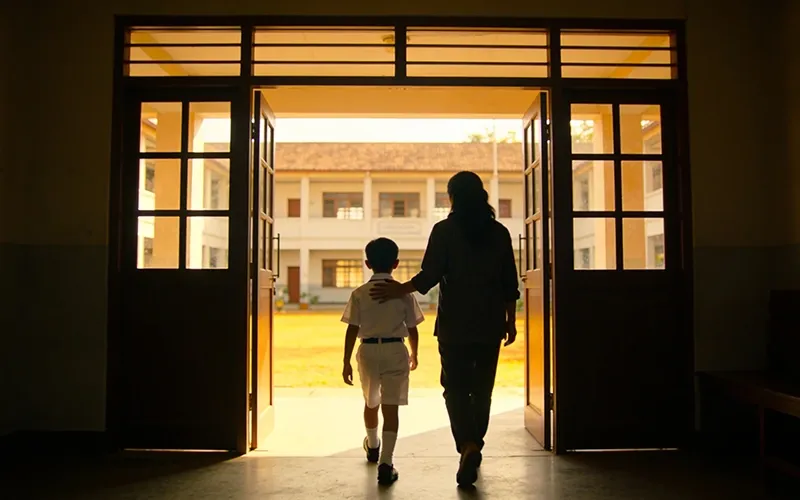
Several months after the classroom moment that left him speechless, Raka was asked once again to introduce himself in English.
This time, he spoke.
His pronunciation was not perfect.
His sentences were simple.
He made mistakes.
But he tried.
And perhaps that is the most meaningful sign of progress.
Because the future of education will not be defined solely by how much technology children have access to.
Nor by how many hours they spend online.
The more important question is this:
Children have never been closer to English than they are today.
But are we helping them turn exposure into genuine fluency?
That may be the defining educational challenge for a generation growing up in a digital world.
***

Previous
10 Tips Kepsek Tingkatkan Mutu Sekolah
Next
Peluncuran LearningRoom & CSR Panti Asuhan


10 Jun - 3 min read

10 Jun - 3 min read

10 Jun - 3 min read

10 Jun - 3 min read
Paling banyak dibaca
01
10 Jun - 3 min read
01
10 Jun - 3 min read
01
01
10 Jun - 3 min read
01
10 Jun - 3 min read
01
10 Jun - 3 min read
01
10 Jun - 3 min read
01
10 Jun - 3 min read
01
10 Jun - 3 min read
01
10 Jun - 3 min read
01
10 Jun - 3 min read
01
10 Jun - 3 min read

5/6/2024 5:11:50 AM - 3 min read

6/27/2024 8:10:51 AM - 3 min read
6/3/2026 4:04:11 AM - 3 min read

10/15/2024 4:40:33 AM - 3 min read

5/6/2024 8:04:23 AM - 3 min read

7/11/2025 4:26:17 AM - 3 min read

5/6/2024 8:06:24 AM - 3 min read

6/10/2024 3:29:56 AM - 3 min read

5/6/2024 5:21:03 AM - 3 min read

5/28/2024 11:02:22 AM - 3 min read

1/30/2025 11:15:01 AM - 3 min read

8/7/2024 3:54:20 AM - 3 min read