

Diterbitkan pada 09 Januari 2025

Bagikan artikel:
In this fast-paced era of globalization, change is the only constant. In the world of education, particularly in English language teaching, the ability to adapt to change is crucial. Teachers and school principals face the challenge of selecting teaching methods that are not only relevant but also effective for their 21st-century students.
English, as an international language, opens doors for students to greater opportunities, both academically and professionally. Therefore, choosing the right teaching methods is the first step towards creating a generation that is competent and confident in using this language.
English language teaching in the 21st century faces various new challenges and opportunities. With the development of technology and changes in learning needs, various modern teaching methods have been developed to ensure effective and relevant English language learning.

Here are some commonly used and relevant teaching methods in the modern era:
1. Task-Based Learning (TBL)
- Focuses on completing real-world tasks, such as writing emails or presenting projects.
- Helps students understand the practical applications of English in everyday life.
2. Blended Learning
- Combines face-to-face learning with online learning.
- Provides flexibility for students to learn at their own pace.
3. Communicative Language Teaching (CLT)
- Emphasizes real communication as the primary goal of learning.
- Helps students build confidence in speaking English.
4. Gamification
- Uses game elements in education to increase student engagement.
- Examples: using apps like LearningRoom or Duolingo.
5. Flipped Classroom
- Students learn the material independently before class, so class time is more focused on discussion and practice.
6. Project-Based Learning (PBL)
- Project-based, where students collaborate to complete major tasks, such as creating videos or organizing events.
- Enhances collaboration and creativity skills.

With the variety of 21st-century learning methods, selecting a method to implement becomes a crucial step for teachers and school principals in improving the quality of education.
There are several factors to consider before deciding which method to apply. By considering the following factors, it is hoped that the learning process can run more effectively, tailored to the conditions and needs of each school.
1. Student Needs
- Are your students beginners or at an intermediate/advanced level?
- Do they prefer visual, auditory, or kinesthetic learning?
2. School Resources
- Does the school have access to technology or other supporting devices?
- How much time and budget can be allocated?
3. Local Context
- Is the method relevant to the students' culture and environment?
- Are there specific cultural or social barriers that need to be addressed?
4. Teacher Competence
- How familiar are the teachers with the method?
- Is additional training required to implement this method?
To make it easier for teachers and school principals to make decisions, we also present the advantages and disadvantages of each modern learning method in the following table.
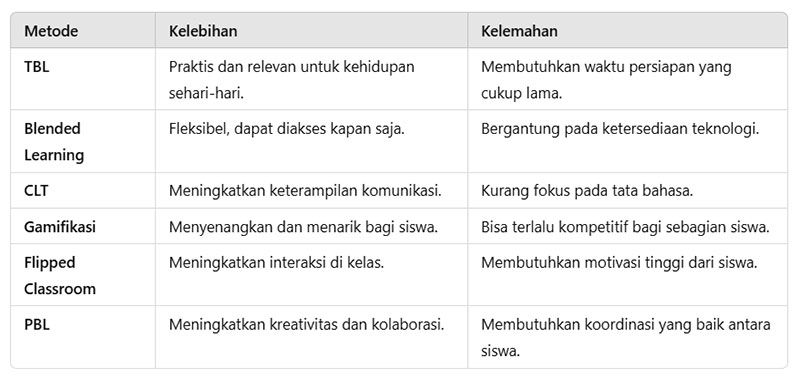
To choose the right teaching method, the first step is to evaluate the needs of the school and students. This can be done through surveys that identify students' learning preferences and analyses of their strengths and weaknesses in English. A deep understanding of these needs will help in selecting the most suitable method.
Begin the implementation of the teaching method gradually. Avoid trying too many methods at once. Choose one method and implement it step-by-step to ensure its effectiveness before trying another method. Combining various methods can also yield the best results, as no single method is perfect. Trying the best elements from multiple methods can improve the overall quality of learning.
It is also important to provide training for teachers to ensure they have a deep understanding of the chosen method. Training or workshops will enhance their competence and ensure they can effectively implement the method. Additionally, conduct regular evaluations to measure the effectiveness of the teaching methods used. Solicit feedback from students and teachers for further improvement so that the learning process can continually be enhanced.

To conclude this article, we hope that teachers and school principals can realize how choosing the right English teaching methods is a crucial step to help students succeed in the era of globalization.
The considerations required to determine the ideal teaching methods include student needs, available resources, and the local context, so that teachers and school principals can create relevant, engaging, and impactful learning experiences.
In the 21st century, adaptation and innovation are key. Teachers who continue to learn and innovate will be able to create a generation that is ready to face global challenges. Let us invest together in better education for a brighter future!
***
Join the Adventure and Learn English at
Sebelumnya
Alasan Anak Wajib Mulai Belajar Bahasa Inggris Sejak Dini?
Berikutnya
10 Platform Game Belajar Bahasa Inggris


10 Jun - 5 menit baca

10 Jun - 3 menit baca
10 Jun - 3 menit baca

10 Jun - 4 menit baca
Paling banyak dibaca
01
10 Jun - 8 menit baca
01
10 Jun - 5 menit baca
01
01
10 Jun - 4 menit baca
01
10 Jun - 4 menit baca
01
10 Jun - 3 menit baca
01
10 Jun - 5 menit baca
01
10 Jun - 3 menit baca
01
10 Jun - 4 menit baca
01
10 Jun - 3 menit baca
01
10 Jun - 2 menit baca
01
10 Jun - 3 menit baca

06 Mei - 8 menit baca

27 Jun - 5 menit baca

15 Okt - 4 menit baca

06 Mei - 4 menit baca

11 Jul - 3 menit baca
06 Mei - 5 menit baca

10 Jun - 3 menit baca

06 Mei - 4 menit baca

28 Mei - 3 menit baca
30 Jan - 2 menit baca

07 Agt - 3 menit baca

Suka dengan Artikel Ini?
Berlangganan newsletter kami untuk mendapatkan artikel menarik dan penawaran khusus langsung melalui email.
Gratis dan berhenti berlangganan kapan saja.

Ingin membaca lebih banyak artikel seperti ini?
Berlangganan newsletter bulanan kami.