

Diterbitkan pada 18 November 2026

Bagikan artikel:
There is a lot for teachers to think about before a lesson even begins.
What should students learn today? What should they be able to do by the end of the lesson? Which activities are appropriate for their level? How much time will each activity take? What happens when some students understand the material quickly while others need more support?
And that is only part of the preparation.
Teachers may also need to think about learning materials, classroom resources, assessments, follow-up activities, and even a backup plan in case something does not work as expected.
For experienced teachers, some of these decisions may become part of a familiar routine. But for teachers who are still finding their footing—especially those who are new to teaching English—lesson preparation can sometimes feel like trying to put together many pieces at once.
It is easy to spend hours searching for examples, adapting formats, looking for activities, or staring at a blank document without knowing where to begin.
But an English lesson plan should not exist simply as a document to complete.
At its best, a lesson plan helps teachers answer more meaningful questions:
When those questions have clear answers, lesson preparation becomes more than a list of materials or classroom activities.
It becomes a map.
A good lesson plan connects learning objectives, content, language focus, classroom activities, learning resources, and assessment into a clear and purposeful learning experience.
Different schools and education systems may use different terms for teaching plans and instructional documents. In Indonesia, teachers may be familiar with terms such as RPP or Modul Ajar. Regardless of the format or terminology, however, the central challenge remains the same:
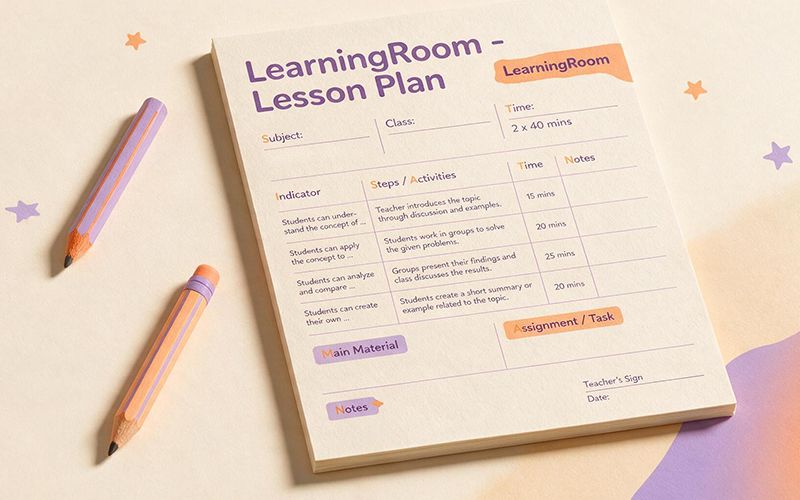
How do you create a learning plan that is clear, realistic, and genuinely useful in the classroom?
This guide will walk you through the process of creating an English lesson plan step by step—from identifying learning goals and selecting content to planning classroom activities, preparing assessments, and reflecting on the lesson afterwards.
You will also find examples for different school levels and a free English lesson plan template that can help you get started.
So, if planning a lesson often feels like starting from a blank page, begin with a different question.
Instead of asking: “What should I write?”, try asking: “What do I want my students to be able to do after this lesson?”
That is often where meaningful lesson planning begins.
Simply put, a lesson plan is a structured guide that helps teachers prepare the direction, learning process, and assessment of a lesson.
For English teachers, a lesson plan can help organise:
⇢ what students are expected to achieve;
⇢ the topic or content they will learn;
⇢ the vocabulary, expressions, or language features they need to focus on;
⇢ the language skills they will develop;
⇢ teacher and student activities;
⇢ learning materials and resources;
⇢ assessment methods;
⇢ follow-up activities..
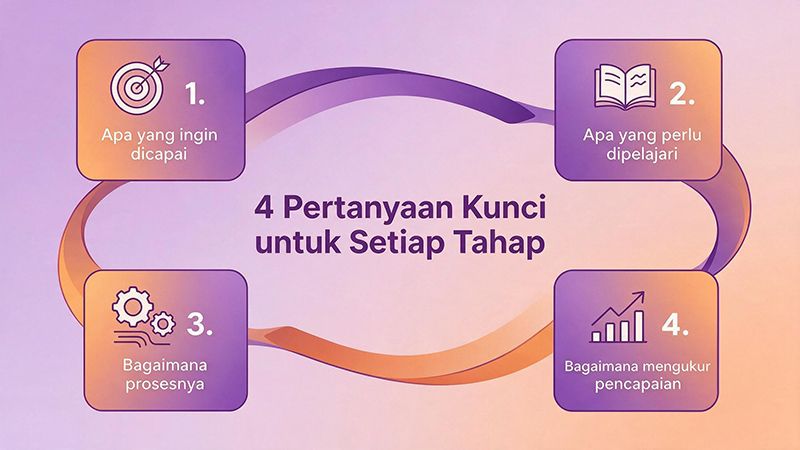
In other words, a lesson plan helps answer four basic questions:
A good lesson plan does not need to be long or complicated.
What matters most is the connection between learning objectives, content, activities, and assessment.
Teachers may use different terms when talking about instructional planning.
Depending on the context, these may include:
In this article, the term lesson plan is used as a broad way to describe the process of planning a structured learning experience.
The framework can also be adapted to support teachers who are preparing a Modul Ajar or other teaching documents used in their schools.
The most important question is not simply what the document is called.
Instead, ask:
Does this plan actually help me design and deliver a more purposeful learning experience?
If it does, then it is serving its most important purpose.
Teaching English involves much more than explaining vocabulary or asking students to complete exercises.
In a single lesson, students may need opportunities to:
⇢ listen to English;
⇢ understand vocabulary;
⇢ notice language patterns;
⇢ practise writing;
⇢ speak and interact;
⇢ use language in a meaningful context.
Without a clear plan, a lesson can easily become a collection of disconnected activities.
Students might:
All of these activities can be useful. But teachers still need to ask:
What are students actually learning through these activities?
This is where lesson planning becomes important.
A clear lesson often follows a simple connection:
Learning Objective
↓
Content and Language Focus
↓
Learning Activities
↓
Assessment
When this connection is clear, teachers are not simply choosing activities because they look interesting or entertaining.
Each activity has a purpose.
Each activity helps students move towards the ability they are expected to develop.
For newer teachers, a lesson plan can also serve as a guide during the teaching process. Instead of trying to make every decision in the moment, teachers have a clearer sense of where the lesson is going and what needs to happen next.
There is no single lesson plan format that works for every teacher.
An English lesson plan for primary school students may look very different from one designed for middle or high school students.
The differences may include:
However, despite these differences, several key components can help teachers plan lessons more systematically.
The following structure is based on the LearningRoom English Lesson Plan template.
Start with the basic context of the lesson.
This may include:
This section may seem simple, but it helps ensure that the rest of the lesson plan is developed with the right learning context in mind.
This section establishes the direction of the lesson before you decide which activities to use. A common mistake is to look for games, worksheets, or teaching videos before identifying the ability students are expected to develop.
A more purposeful plan starts with two questions: What ability do you want students to develop? And what should they be able to do by the end of the lesson?
Learning outcomes describe the broader abilities students are expected to develop.
Example: Students are able to use simple English to interact with others and share personal information in situations related to everyday life.
Learning objectives are more specific to the lesson being planned. To keep the lesson focused, teachers may set up to three main objectives.
Example: By the end of the lesson, students will be able to:
These objectives will guide the selection of lesson content, activities, and assessment methods.
A good lesson should not be designed around ideal conditions alone. Teachers also need to consider what is available and what can realistically be used. In the LearningRoom template, this section is divided into four components.
⇢ Laptop
⇢ Projector
⇢ Whiteboard
⇢ Flashcards
⇢ Worksheets
⇢ Speakers
⇢ Pictures
⇢ Instructional videos
⇢ Classroom
⇢ Internet connection
⇢ Digital devices
⇢ Space for group activities
⇢ Shared speakers
Example: If the projector or internet connection is unavailable, the teacher can use flashcards and printed dialogue examples instead.
A simple backup plan like this can make a lesson plan much more practical and classroom-ready.
Once the learning objectives are clear, decide what students will actually learn. This section makes the lesson plan more specific.
Ask yourself: What is the main topic, concept, or subject matter students will learn?
Example: Greeting and Introducing Yourself, including common greetings, introducing one’s name, and sharing basic personal information.
English lessons do not always need to revolve around one particular text type. Teachers may use:
⇢ Dialogues
⇢ Narrative texts
⇢ Descriptive texts
⇢ Procedure texts
⇢ Recount texts
⇢ Audio recordings
⇢ Videos
⇢ Pictures
⇢ Informational texts
In addition to choosing the input or material, teachers can explain the context in which the language will be used.
Example: A simple conversation between two people meeting for the first time.
Context helps students understand that language is used in real situations, rather than in isolation.
Identify the language features that are genuinely relevant to the lesson. You do not need to include every component, choose only those that support your learning objectives.
Next, identify the main skills you want students to develop. These may include:
⇢ Listening
⇢ Speaking
⇢ Reading
⇢ Writing
⇢ Viewing
⇢ Presenting or communicating
You can also identify the strategies students will use. For a narrative text, for example, students might identify the main idea, locate key information, make inferences, and summarise the story. In a speaking lesson, they might use sentence starters, practise with a partner, and take part in a role-play.
This way, teachers plan not only what students will learn, but also how they will learn and use their skills.
This section explains how the lesson plan will be translated into classroom activities. For easier planning, divide the lesson into three main stages:
For each stage, you can include the activity or stage name, duration, teacher activities, and student activities.
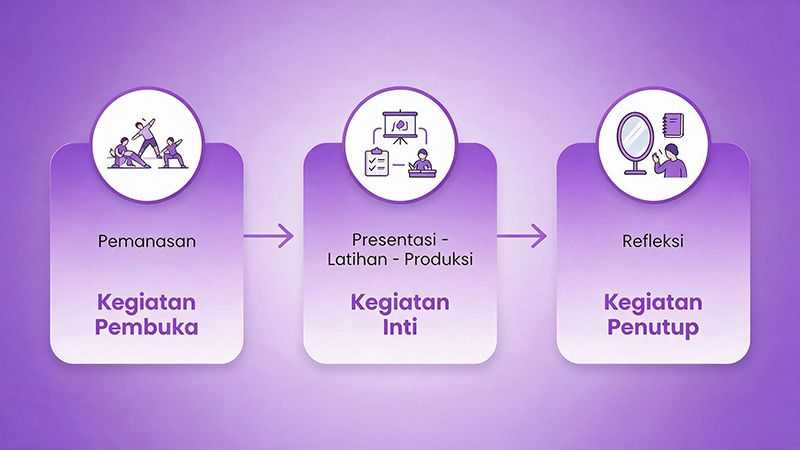
The opening stage helps students get ready to learn and connects the new lesson with what they already know or have experienced.
⇢ Teacher activity: Greet students using simple expressions such as Hello, Hi, and Good morning.
⇢ Student activity: Respond to the greetings and repeat the expressions, paying attention to pronunciation.
⇢ Teacher activity: Show a picture of two people meeting and ask simple questions to draw on students’ prior experiences.
⇢ Student activity: Observe the picture and answer based on their existing knowledge or experiences.
The main stage gives students opportunities to understand, practise, and use the language.
The teacher introduces the topic, vocabulary, expressions, or examples of language use.
⇢ Teacher activity: Introduce greeting expressions and vocabulary, then model their pronunciation and a simple dialogue.
⇢ Student activity: Listen, observe, and repeat the expressions introduced.
Students begin practising with support, examples, or scaffolding.
⇢ Teacher activity: Provide a sample dialogue and sentence starters to support students’ practice.
⇢ Student activity: Complete the dialogue and practise it with a partner.
Students begin using the language more independently.
⇢ Teacher activity: Monitor students’ activities and provide support when needed.
⇢ Student activity: Take part in a role-play in which they greet a classmate and introduce themselves.
The closing stage helps students review what they have learned and understand what comes next. It may include:
The teacher and students recap the key points covered during the lesson.
The teacher uses a short activity to check students’ understanding.
Example: Ask students to introduce themselves in two or three sentences.
Students can respond to simple questions such as “What did you learn today?” or “What was easy or difficult for you?”
The teacher acknowledges students’ efforts and provides feedback on their learning process or outcomes.
The teacher explains what students will do next, such as additional practice, remedial activities, enrichment, or preparation for the next topic.
These stages do not need to be followed rigidly. Adjust them to the lesson duration, content, and students’ needs.
Assessing English learning does not always require a written test. Assessment methods for primary school students may differ from those used for junior or senior high school students. The method should also match the ability being assessed.
For example, speaking is better assessed through a conversation or performance, while reading may require students to read and demonstrate their understanding of a text.
Teachers can plan for three main assessment purposes.
Diagnostic assessment is used to understand students’ readiness and starting abilities.
Assessment method: A short question-and-answer session or brainstorming.
What to observe or identify: Students’ initial ability to recognise and use greeting and self-introduction expressions.
Formative assessment is used to monitor students’ progress and understanding throughout the learning process.
Assessment method: Observe students while they practise dialogues.
What to observe or assess: Their ability to use the expressions, introduce themselves, and pronounce the phrases clearly.
Summative assessment is used to review students’ achievement after they have completed a topic or a sequence of lessons.
Assessment method: A simple paired conversation.
What to assess: Students’ ability to independently use greeting and self-introduction expressions in a simple conversation.
There is no single rubric that works for every lesson. Rubrics may vary depending on students’ grade level, learning objectives, skills being assessed, task type, and content complexity.
For a basic speaking lesson, assessment criteria may include:
At higher levels, assessment criteria may expand to include:
⇢ Content
⇢ Organisation
⇢ Vocabulary
⇢ Grammar
⇢ Pronunciation
⇢ Fluency
A lesson plan does not need to include every detail of the rubric. Teachers can state the assessment method and the aspects they intend to observe, then use a suitable assessment instrument or rubric.
Learning does not necessarily stop when students leave the classroom. Teachers can plan additional activities to help students reinforce, apply, or continue what they have learned.
Activity | Description / Instructions | Resources |
Find Your Partner | Students find a partner using information cards, then greet each other and introduce themselves. | Conversation cards |
Introduce Your Friend | Students interview a classmate and introduce that person to the group. | Worksheet and stationery |
Mini Role-play | Students act out a conversation in which they meet someone for the first time. | Role-play prompt cards |
This format makes it easy to see how each activity connects to the resources required.
Not every post-lesson activity needs to be compulsory homework. Teachers can decide whether an activity is required or optional.
Example of a required activity
⇢ My Self-Introduction Card: Students create a simple introduction card containing their name, age, and a few details about themselves, using the sentences they have learned.
Example of an optional activity
⇢ Practice at Home: Students practise introducing themselves in English to a family member.
This approach gives teachers more flexibility in planning follow-up activities instead of relying only on conventional homework.
A lesson plan does not have to be put aside as soon as the lesson ends. The Teacher Reflection section helps teachers record what worked, what could be improved, and what should be considered for the next lesson.
Teachers can use questions such as:
Reflection does not need to be lengthy. Even a few notes after class can help teachers improve their lesson planning over time.
The same lesson plan structure can be used across different school levels. What needs to change is the complexity of the content, the activities, and the abilities students are expected to develop.
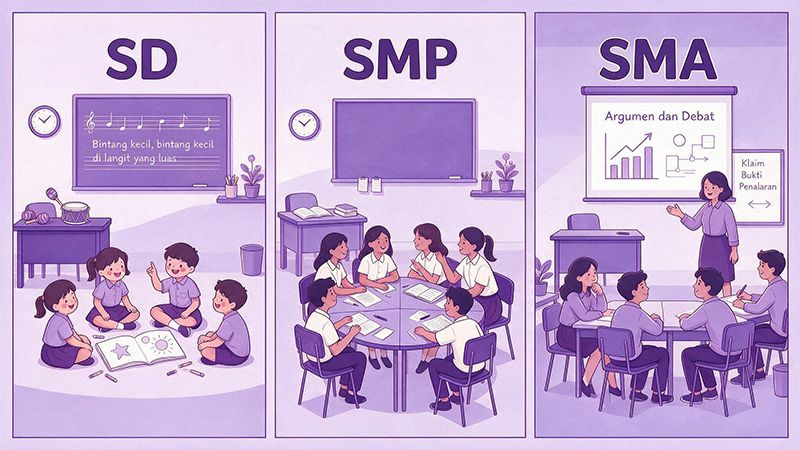
Lessons at this level can make greater use of:
⇢ Pictures
⇢ Songs
⇢ Games
⇢ Short dialogues
⇢ Pair work
⇢ Visuals and concrete examples
Example topic: Greeting & Introducing Yourself
Focus: Using simple expressions to greet others and introduce oneself.
Students can begin working with:
⇢ More structured texts
⇢ Collaborative activities
⇢ Simple discussions
⇢ A wider range of language skills
Example topic: Describing People
Focus: Describing a person using appropriate vocabulary and language structures.
At this level, students can take part in activities that require greater analysis and independence, such as:
⇢ Text analysis
⇢ Discussions
⇢ Presentations
⇢ Writing tasks
⇢ Projects
⇢ Developing and presenting arguments
Example topic: Expressing Opinions and Arguments
Focus: Expressing and supporting opinions with relevant reasons and appropriate language.
The overall lesson plan structure can remain the same. What changes is the depth of the content, the types of activities, and the complexity of the expected learning outcomes.
The following principles can help make your lesson planning more effective.
Do not begin by searching for activities. First, ask: What should students be able to do when the lesson is over? The answer will help you choose the content, activities, and assessment methods.
Teachers may want to cover vocabulary, grammar, speaking, listening, pronunciation, and writing. However, these do not all need to be the main focus of a single lesson. Set clear priorities.
For example: Main skill — Speaking; Language focus — Greetings and Self-Introduction; Supporting skill — Listening.
A clearer focus makes the lesson easier to plan and deliver.
A simple progression can be used:
The teacher provides a model
↓
Students practise with support
↓
Students use the language more independently
This approach is particularly helpful when teaching speaking and writing.
The best lesson plan is not necessarily the one with the most activities. Consider:
⇢ Class size
⇢ Available lesson time
⇢ Facilities
⇢ Internet access
⇢ Students’ abilities
One simple activity that can be completed well is often more effective than five activities that cannot be finished.
Ask yourself:
A few notes about alternative arrangements can make a lesson plan better prepared for real classroom conditions.
Formative assessment can help teachers identify:
In this way, assessment is not only a way to assign grades. It also helps teachers make informed decisions during the learning process.
***
Sebelumnya
Pendidikan Berkualitas, Bangsa Cerdas
Berikutnya
Kerja Sama Disdik Banjarmasin & LearningRoom


10 Jun - 5 menit baca

10 Jun - 3 menit baca

10 Jun - 3 menit baca
10 Jun - 4 menit baca
Paling banyak dibaca
01
10 Jun - 8 menit baca
01
10 Jun - 5 menit baca
01
01
10 Jun - 4 menit baca
01
10 Jun - 4 menit baca
01
10 Jun - 3 menit baca
01
10 Jun - 6 menit baca
01
10 Jun - 3 menit baca
01
10 Jun - 4 menit baca
01
10 Jun - 3 menit baca
01
10 Jun - 2 menit baca
01
10 Jun - 3 menit baca

06 Mei - 8 menit baca

27 Jun - 5 menit baca

15 Okt - 4 menit baca

06 Mei - 4 menit baca

11 Jul - 3 menit baca

06 Mei - 6 menit baca

10 Jun - 3 menit baca

06 Mei - 4 menit baca

28 Mei - 3 menit baca
30 Jan - 2 menit baca

07 Agt - 3 menit baca

Suka dengan Artikel Ini?
Berlangganan newsletter kami untuk mendapatkan artikel menarik dan penawaran khusus langsung melalui email.
Gratis dan berhenti berlangganan kapan saja.

Ingin membaca lebih banyak artikel seperti ini?
Berlangganan newsletter bulanan kami.