Published on June 02, 2026

Bagikan artikel:
It was a Tuesday afternoon. My kid was sitting at the table, textbook open, pencil in hand, and completely somewhere else. Eyes drifting. Fingers tapping. Mentally checked out. And I heard myself say, for what felt like the hundredth time: “Can you please just focus?”
She looked up. Then went right back to wherever she was.
That moment hit differently than usual. Because it wasn’t really about her. It was about me realising that I’d been so fixated on making her study that I’d never stopped to ask why it felt so hard for her in the first place.
Kids don’t lose focus because they’re lazy. They lose focus because the environment, the routine, and the emotional signals around them aren’t set up to support it.
If you’re reading this, I’m guessing you’ve been in that same spot. The good news? There are real, practical shifts you can make — starting today, with what you already have at home.
A child’s brain is far more distracted by what it sees than what it hears. Toys in the corner, colourful posters, a TV on in the next room, all of it competes for their attention. You don’t need a fancy setup. A clean, simple, low-stimulation space is already a massive upgrade.
Twenty minutes of focused study at the same time every day beats two hours on a Sunday afternoon. Children’s brains thrive on rhythm and predictability. Once their body ‘knows’ that 4pm is study time, getting into focus mode becomes so much easier, no negotiating required.
We tell our kids to put down the gadgets, then quietly check our messages mid-session. Kids learn from what they observe, not what they’re told. Try a family agreement: during study time, all screens, theirs and yours, go face-down. It’s a small act with a surprisingly big impact.
Research from Stanford found that the way parents frame their words directly influences a child’s motivation to learn. It’s not how firmly you say it but it’s what you say, and how.
Try asking, “What was the most interesting thing you learnt today?” or “Was there anything that confused you?” These questions invite a real conversation instead of a guilty one-word answer. That emotional connection — feeling heard — is actually the foundation of genuine motivation to learn.
Instead of “You’re so smart!”, try “You really pushed through that. I saw how hard you tried.” Process-based praise builds a growth mindset: the belief that ability improves through effort. Kids raised with this mindset are naturally more persistent when things get tough.
Did you know? A University of Chicago study found that children aged 5–8 who regularly received process-based praise showed twice the persistence on difficult tasks compared to children praised for being naturally smart.
This sounds counterintuitive, but the science backs it up. Even 10–15 minutes of light physical activity like a quick jog around the block, some jumping jacks, or a bit of play outside significantly boosts blood flow to the prefrontal cortex, the part of the brain that manages focus and decision-making.
Sugary snacks give a quick energy spike, followed by a crash that leaves kids sluggish and distracted. Reach for protein-rich or complex carb snacks instead for steadier, longer-lasting brain fuel. It’s a small swap with real results.
The Pomodoro technique isn’t just for adults. For primary school kids, a 15-minute focus block followed by a genuine 5-minute break is far more productive than forcing them to sit for an hour. Give them a visible timer, and actually let them rest when the break kicks in. No guilt, no “just five more minutes.”
The unspoken question in every child’s head during study time is: “Why does this even matter?” We forget to answer it, and without an answer, it’s hard to care.
Does your kid obsess over football? Use player statistics to make maths click. Into cooking? Measuring ingredients is a real-world fractions lesson. Connections between schoolwork and their actual world create relevance, and relevance is the strongest fuel for sustained focus there is.
Autonomy is a core psychological need for kids as much as adults. “Do you want to start with Maths or English?” hands them a sense of control that dramatically increases their buy-in and internal motivation. This isn’t indulgence. It’s building ownership over their own learning journey.
Learning isn’t a sprint to be won today. It’s a long marathon, and your job isn’t to push from behind. It’s to run slowly, steadily, right beside them.
That afternoon, I closed her textbook and asked: “If you could learn anything in the whole world, what would it be?”
Her eyes lit up. She talked non-stop about dinosaurs, space, and how robots are built.
For the first time in a long time, I saw a child who was hungry to learn, not one who was being told to.
And I realised: our job isn’t to ignite that fire from scratch. Our job is to make sure we don’t accidentally put it out.
***
Previous
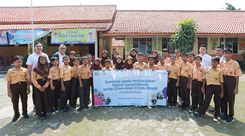
Sosialisasi LearningRoom di Kupang Berjalan Lancar dan Siap Pakai di Sekolah Bulan Juli 2024
Next
Game Interaktif, Belajar Inggris Efektif
02 May - 3 min read
10 Jun - 3 min read

29 Jul - 3 min read

29 Jul - 3 min read

29 Jul - 3 min read
29 Jul - 3 min read
02 Aug - 3 min read

02 Aug - 3 min read

02 Aug - 3 min read
Paling banyak dibaca
01
02 Aug - 3 min read
01
02 Aug - 3 min read
01
02 Aug - 3 min read
01
02 Aug - 3 min read
01
02 Aug - 3 min read
01
02 Aug - 3 min read
5/17/2024 3:31:50 AM - 3 min read

5/6/2024 5:11:50 AM - 3 min read

5/6/2024 5:08:33 AM - 3 min read

5/6/2024 8:06:24 AM - 3 min read

5/30/2024 9:40:52 AM - 3 min read

6/10/2024 3:29:56 AM - 3 min read